By Annie Oeth
UMMC communications
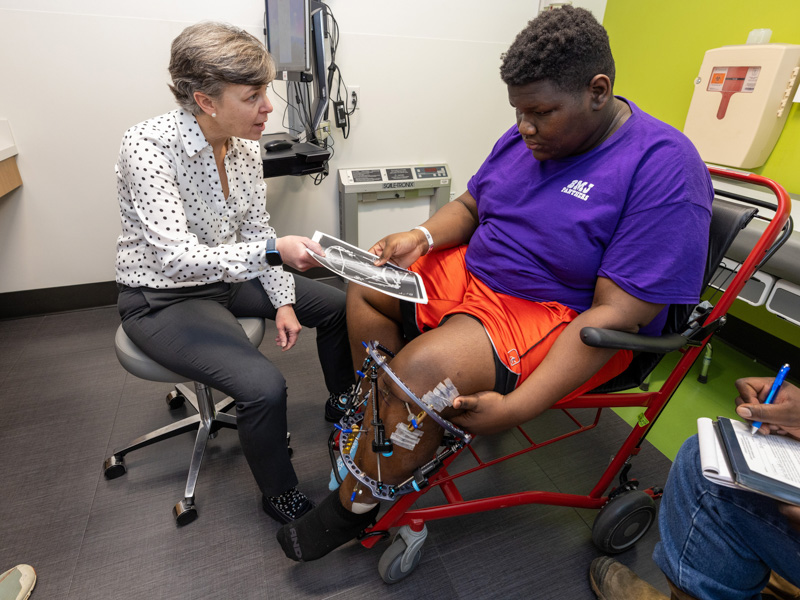
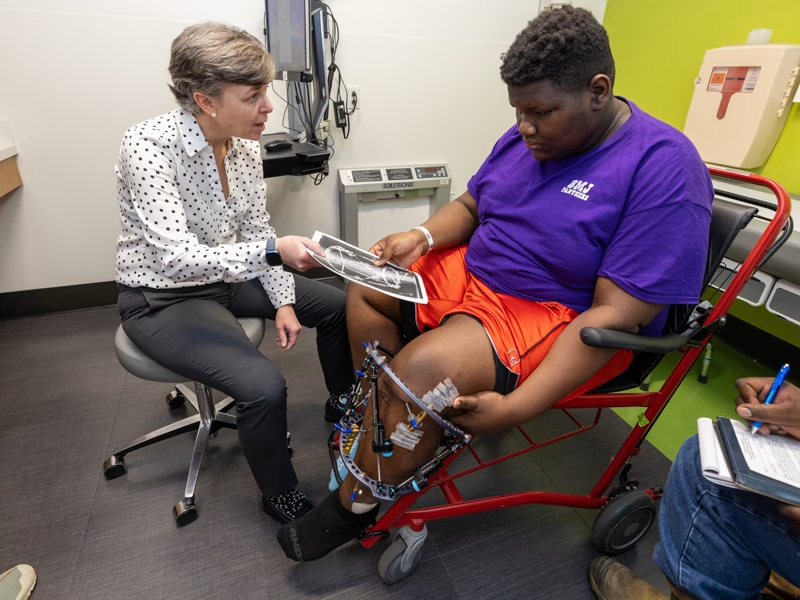
While Paul Sykes goes about a day at Bettye Mae Jack Middle School in Morton, spends time with friends and or is at home with family, a robotic device is making tiny adjustments to reshape his shin bone.
He is the first pediatric patient in Mississippi to use the Maxframe Autostrut multi-axial correction system. Approved by the U.S. Food and Drug Administration in 2022, the device was installed for the first time in Mississippi on March 21. It is the first fully automated orthopaedic implant in the world.
Paul’s orthopaedic surgeon at Children’s of Mississippi, Dr. Kellie Leitch, professor and chief of pediatric orthopaedics and rehabilitation at the University of Mississippi Medical Center, was among a handful of surgeons around the country to train with Johnson & Johnson on the robotics device, which was created by DePuy Synthes, one of the companies that make up Johnson & Johnson Medical Devices Group.
Leitch surgically placed the frame around Paul’s tibia during spring break in March. A week later, Paul was back at Children’s of Mississippi’s Kathy and Joe Sanderson Tower for the Autostrut to be placed for treatment of his Blount’s disease.

A genetic growth disorder of the shin bone at the knee, Blount’s disease causes the growth plate at the inside of the knee to make less bone or stop growing. Since the growth plate at the outside of the knee keeps growing, this can leave children with one or both legs bowed.
When left untreated, the condition can result in chronic knee pain and the need for knee replacements at an early age.
“We thought at first that his growth was normal,” said his father, Paul Sykes Jr. While many young children have bowed legs, bowing worsens for children with Blount’s disease as they grow. Adolescent Blount’s disease occurs in children 10 years and older.
“Attachment of the robot allows us to relieve the family of the responsibility of managing a complicated spatial frame prescription,” Leitch said. “This improves the opportunity for an excellent deformity correction resulting in a straight leg.”
The smaller adjustments are less painful than the larger adjustments that would be made by a parent, caregiver or patient two or three times a day under the former treatment plan.
Once a care plan is set, information on the adjustments needed are downloaded into the Maxframe Autostrut software. The device is then placed along the framework where it can make up to 20 micro-adjustments throughout the day.

“This is easier for parents. They have full schedules with work and family. It’s also better for patients,” Leitch said. “Studies have shown that these micro-adjustments also help the new bone grow significantly better.”
The lightweight device works quietly, and patients can wear the device even when showering or doing hydrotherapy, said Zach Wade, a Johnson & Johnson consultant who traveled to Children’s of Mississippi for the device’s installation.
A Wi-Fi connection is needed for a care plan to be loaded into the Autostrut, but after that, internet service isn’t required. The device is armed with enough battery power for the duration of treatment.
A seventh-grader, Paul is going through 40 days of treatment with the Maxframe Autostrut device as well as physical therapy and gait training this spring.
A guard on the Panthers football team at school, he hopes to be back on the football field in the fall.
“Treatment will be done before I start eighth grade,” he said.